
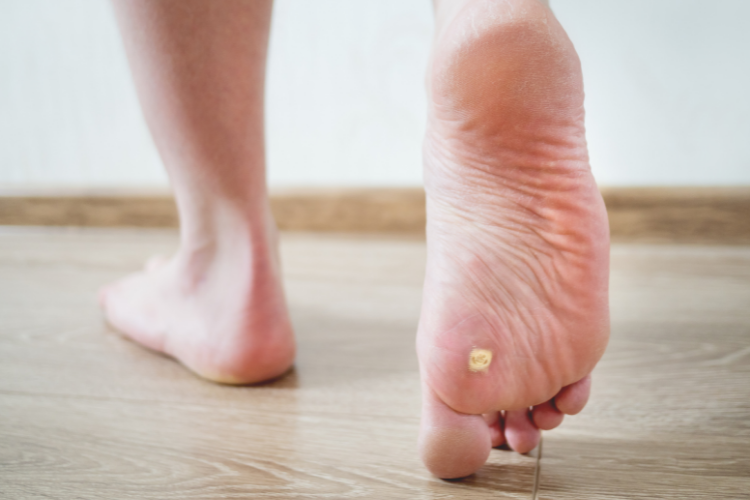
Warts & Verrucae treatment.
What Are Verrucae?
Verrucae are warts that develop on the feet and are caused by the human papillomavirus (HPV). They are generally harmless and may not require treatment unless they are painful, growing, spreading or causing concern.
Verrucae often appear as small, rough or cauliflower-like areas of skin. Tiny black or red dots may be visible within them; these are small blood vessels within the affected tissue.
Many verrucae eventually clear without treatment as the immune system recognises and responds to the virus. In children, this often happens within 6-12 months, although verrucae may take longer to resolve in adults - sometimes up to two years.
If you have tried suitable home treatments without success, or would prefer professional treatment, we can offer several options. Acid-based treatments and home-freezing products may not be suitable for everyone. People with diabetes, poor circulation, reduced sensation in their feet or a weakened immune system should seek professional advice before attempting to treat a verruca themselves.
The simplest treatment we offer is debridement, which involves carefully removing the hard skin that can develop over and around the verruca. This can reduce pressure and discomfort while allowing suitable home treatments to reach the affected tissue more effectively.
Please be aware that no verruca treatment is guaranteed to work. Treatments aim to remove or disrupt the affected tissue and encourage the body’s immune system to recognise and clear the virus. Several appointments may be needed, and we may occasionally recommend a break from treatment if the verruca appears to be resolving naturally.
Treatment Options
Caustic and Acid Treatments
Depending on the verruca and your individual circumstances, we may recommend treatment with silver nitrate, salicylic acid or Verrutop.
Verrutop is a professional topical treatment containing Nitrizinc Complex. When applied to the verruca, it causes the affected tissue to dehydrate and gradually break down.
Verrutop is usually applied at intervals of 7–14 days. To support the drying process, you will normally be advised to apply surgical spirit to the treated area twice daily between appointments.
A course of treatment may involve between one and six applications, depending on the size, location and response of the verruca. If it has not resolved after the recommended course, we will review the area and discuss whether another treatment option may be more suitable.
Verruca Needling
Verruca needling is a minor procedure intended to stimulate the body’s immune response to the virus. It may reduce the size of a verruca or help it to resolve completely, although results vary and clearance cannot be guaranteed.
The area is first numbed using a local anaesthetic. We will then select a suitable verruca to treat—usually the largest or thickest lesion—and carefully remove the hard skin covering it. A sterile needle is then used to puncture the verruca repeatedly, creating a controlled wound and exposing the affected tissue to the immune system.
We will normally review the area approximately seven days after the procedure. It may take several months, and sometimes up to six months, to see the full response. The procedure may be repeated where clinically appropriate.
SWIFT Treatment
SWIFT uses controlled microwave energy delivered directly into the verrucal tissue. The energy rapidly heats the affected area, causing localised changes that are intended to stimulate the body’s immune response to HPV.
The treatment targets the affected tissue without cutting the skin or creating an open wound. A course usually involves several appointments, with time between treatments to allow the immune system to respond.
Clinical studies have reported encouraging results for persistent verrucae, including some that have not responded to previous treatments. However, as with all verruca treatments, results vary and complete resolution cannot be guaranteed.